

Table of Contents
- What are the Key Differences Between Instant Vs Gradual Social Media Growth
- Understand How Drip Feed Runs And Intervals Work
- Compare Instant & Gradual Delivery Risks And Costs
- How to Choose A Safe And Practical Social Media Growth Pace
- Instant Or Gradual Social Media Growth: Which Is Better?
- FrequentlyAsked Questions
Digital visibility across competitive online platforms requires tactical execution rather than unplanned post submissions. Establishing a dominant profile presence demands clear choices regarding execution pace. When launching a new brand campaign or expanding an online profile, account holders face a critical choice at checkout: receiving total metrics all at once or pacing delivery over a structured timeframe.
Picking the wrong speed flags account security filters, reduces organic algorithm reach, or exhausts marketing capital without building long-term audience retention. Choosing between rapid bulk execution and controlled batch intervals requires total tactical clarity.
Digital network algorithms process account activity through complex behavioral baselines. When automated security filters observe ten thousand new profile interactions hit an account within five minutes, platform review protocols trigger immediately. Staggering delivery intervals allows social metrics to blend naturally into existing account activity curves. Profile managers need exact knowledge regarding how execution speed influences profile safety, audience retention, and campaign targets across networks such as TikTok, Instagram, and YouTube.
What are the Key Differences Between Instant Vs Gradual Social Media Growth

Selecting a delivery pace on an automated growth platform shapes the algorithm’s perception of your uploaded content. Understanding these execution methods prevents account flags while protecting overall page reach. Digital creators often wonder whether fast delivery versus paced delivery, compared side by side, yields distinct platform reactions. The choice between drip feed or one bulk drop for followers determines whether network servers view metric gains as natural audience expansion or automated traffic manipulation.
Examining how these methods operate reveals clear operational distinctions that impact long-term profile safety. Instant delivery pushes every requested metric to your account immediately, while gradual distribution spreads those numbers out over hours or days.
Consider these primary differences when evaluating pacing options for your pages:
- Delivery Velocity: Instant speed injects all metrics within minutes, whereas gradual pacing releases counts in steady, controlled batches.
- Algorithm Trigger Risk: Massive instant spikes can catch automated security filters, while slow distribution mimics natural viral sharing curves.
- Metric Retention Stability: Gradual additions typically survive platform purges much better because incoming accounts look active and established over time.
- Campaign Timing Alignment: Instant delivery suits emergency marketing pushes or tight launch deadlines, whereas drip pacing fits ongoing, passive audience building.
- Visual Profile Growth: Fast surges create immediate social proof numbers, while steady pacing builds a believable subscriber trajectory for new visitors.
Choosing the right approach depends on your current account status and promotional goals. Brand new pages benefit immensely from slow delivery speeds because sudden influxes often trigger temporary account locks or shadowbans. On the other hand, established accounts with strong baseline engagement can handle faster volume updates without raising automated flags.
Balancing speed against safety ensures your social media investments translate into genuine, lasting visibility rather than short-lived numbers that vanish during the next platform sweep.
What Is Instant Delivery On A Social Media Booster?

Instant delivery dispatches the entire ordered metric volume to a target link as fast as platform routing servers process incoming network requests. Once a checkout transaction completes, automated networks handle the instruction, fulfilling thousands of interactions within minutes or hours depending on platform server load.
Fast processing suits specific emergency marketing goals, such as pushing a sudden viral trend or meeting tight public media deadlines. However, sending high metric volumes instantly to fresh profiles creates technical footprints that moderation software tracks easily.
High-velocity metric acquisition produces immediate visual transformation across account frontends. Placing an instant order sends signal bursts to platform routing nodes, resulting in rapid metric additions. This approach serves campaign scenarios requiring immediate social proof to influence human profile visitors during tight operational windows.
Specific short-term marketing scenarios benefit from rapid delivery:
- Elevating a live broadcast stream to show immediate audience activity to prospective viewers.
- Driving direct traffic to a time-sensitive announcement or promotional post during peak engagement hours.
- Pushing a video post during its initial evaluation window to prompt automated recommendation systems.
- Countering rapid metric drops during a high-stakes competitive launch event.
- Fulfilling tight agency deadlines where corporate clients require immediate delivery verification.
- Creating immediate visual density on brand launching pages before running paid promotional campaigns.
- Supporting time-limited flash sales where customer trust must form within seconds of a page visit.
Rapid delivery forces target profiles to absorb significant metric volume instantly. Without high baseline daily activity, sudden metric surges trigger automated moderation filters. Accounts receiving sudden bulk spikes without prior engagement history risk automated account flags, post reach drops, or mandatory verification locks.
Profile managers needing immediate audience signals can explore options on Sizzle Social Services to select the right delivery parameters for short-term visibility campaigns.
Executing bulk drops without prior historical profile volume distorts account analytics. Recommendation engines evaluate interaction ratios, comparing impressions against completed profile actions. When an account receives ten thousand profile additions inside a brief processing window while post views remain minimal, automated platform filters identify non-organic delivery patterns.
Strategic deployment of rapid metrics requires aligning delivery with high organic profile activity. Pushing bulk metrics to an active post during a live event creates cohesive profile signals, whereas sending bulk metrics to a dormant account alerts security networks.
How Does Gradual Or Drip Feed Delivery Work?
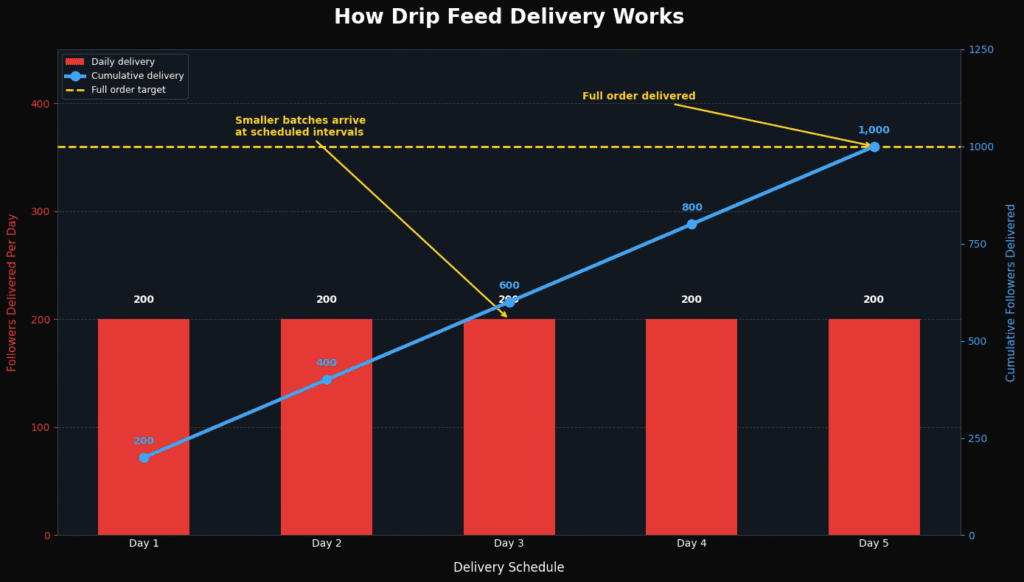
Gradual or drip feed delivery divides a bulk request into smaller, controlled batches sent over scheduled time windows. Rather than receiving 5,000 interactions in one drop, the platform splits order volume into manageable runs across several days. Understanding what gradual delivery means on an SMM panel helps buyers structure long-term growth campaigns without raising security alerts.
Paced distribution relies on automated queue systems that release defined metric allocations at pre-set time intervals. Setting an order for 2,000 followers over four days releases 500 followers every 24 hours. This controlled sequence simulates organic discovery patterns, helping overall account activity align with algorithmic safety thresholds.
Campaign parameters require five specific inputs:
- Quantity Per Run: The exact number of units sent per batch execution.
- Runs: The total number of batches to execute across the schedule.
- Interval: The delay time in minutes between consecutive batches.
- Start Delay: Optional initial buffer time before the first run triggers.
- Target Link: The active profile or content URL receiving the metrics.
Paced distribution mimics natural audience expansion. Recommendation engines register ongoing profile interest instead of isolated metric spikes, keeping account trust metrics intact while building sustained platform authority.
Automated schedulers maintain constant database tracking throughout active run cycles. When a specified interval elapses, system servers execute the next batch request automatically, routing metric units to target links without manual entry.
Maintaining continuous metric arrivals keeps profile analytics looking natural to network monitors. Regular interaction signals over multiple days signal consistent content relevance, encouraging algorithmic algorithms to extend organic post reach.
Compare Instant And Gradual Delivery Speeds
Evaluating delivery speeds requires matching platform mechanics to your marketing objectives. Buyers frequently ask: should growth arrive all at once or in batches to maximize return on investment? Evaluating paced versus instant panel orders reveals distinct operational advantages for each approach.
Rapid delivery suits short-term campaigns where immediate metric displays take priority over platform safety filters. Paced delivery fits long-term profile optimization, offering safe integration with existing organic reach curves. The operational differences dictate how platform algorithms index incoming engagement.
| Feature / Aspect | Instant Delivery | Gradual / Drip Feed Delivery |
| Execution Time | Immediate (Minutes to Hours) | Extended (Days to Weeks) |
| Algorithm Footprint | Concentrated metric surge | Smooth, natural curve |
| Best Use Case | Live streams, urgent trends, time-sensitive posts | Profile building, brand launches, ongoing retainers |
| Risk of Platform Audit | Higher on new or inactive accounts | Minimal when matched to account baseline |
| Setup Complexity | Single entry (Select quantity and submit) | Basic math required (Quantity x Runs x Interval) |
| Order Control | Delivered in a single wave | Monitored and managed batch by batch |
| Refill Efficiency | Sudden drops impact total balance at once | Staggered arrivals trigger smaller refill events |
| Server Routing Queue | High-priority bulk execution | Scheduled background thread execution |
| Account Safety Margin | Low to Moderate | High to Optimal |
| Analytics Curve Impact | Vertical metric spike | Gradual sloped increase |
| Queue Customization | Fixed auto-dispatch | Fully customizable interval timers |
System server performance dictates processing priority across execution queues. Rapid orders command immediate API bandwidth, executing transfers instantly across global proxy nodes. Paced campaigns enter persistent scheduler queues, executing lightweight batches at dedicated timestamps.
Choosing between execution modes depends heavily on post context. Promoting a time-sensitive announcement requires fast metric distribution, whereas managing a corporate page demands steady daily batch arrivals to maintain credibility.
Does Slower Delivery Guarantee Better Follower Retention?
Slower delivery speed does not guarantee higher follower retention on its own. Many buyers ask if does slow delivery keep followers longer, assuming pace dictates account permanence.
Drip feed functions purely as an execution scheduler, managing delivery timing rather than profile quality. Spreading lower-tier network accounts over seven days merely delays audience drop-off. Profile purges still clear non-engaging accounts once platform security audits run.
Long-term retention relies on profile authenticity, account stability, and platform refill guarantees. Controlled pacing prevents rapid security flags, but holding metric gains requires choosing high-grade services backed by solid quality guarantees. Spreading metric distribution over extended timeframes protects account status, but baseline profile quality determines long-term follower counts.
Account holders interested in sustainable page development should review strategies for how to grow Instagram business page followers in Nigeria to align automated metric pacing with authentic profile elements.
Audience purges occur when network security software scans database records for inactive profile flags. Accounts lacking profile photos, custom biographic data, or activity logs get identified during automated system sweeps regardless of initial arrival speed.
Paced delivery minimizes public drop visibility by ensuring metric adjustments happen in small fractions over time. Maintaining stable follower metrics requires choosing high-tier platform infrastructure designed to pass security audits.
Transitioning from basic delivery concepts to active execution requires precise calculation to prevent common order setup errors.
Understand How Drip Feed Runs And Intervals Work
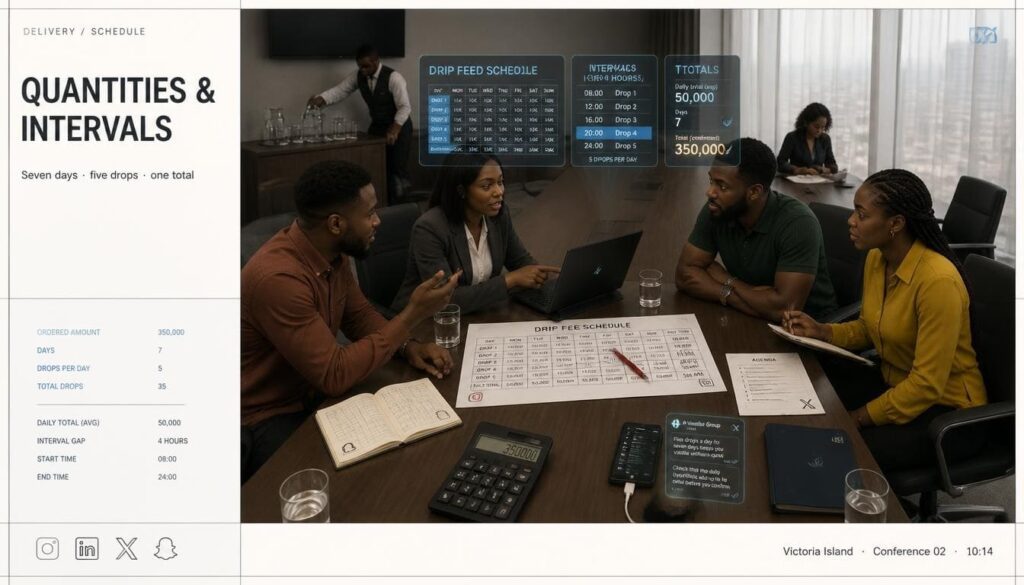
Configuring drip feed options correctly prevents unexpected billing charges or campaign errors. Learning how to set runs and intervals on a drip feed order ensures your campaigns execute as planned.
When managing automated follower delivery, understanding how scheduling parameters interact is crucial. Drip feed systems divide your total order into smaller, manageable chunks spread across specific time frames. This approach mimics natural traffic patterns, keeping your profile safe from sudden algorithm spikes.
Setting up a multi-stage campaign requires balancing two primary factors: the size of each batch and the pause duration between them. If your intervals are too short, your metrics arrive almost as fast as a standard bulk order, defeating the purpose of pacing. Conversely, if your intervals stretch out too long, your campaign might take days to reflect meaningful growth.
Finding the right balance depends on your current promotion timeline and target platform rules. Take time to calculate your total volume against your desired delivery duration before confirming any order. Careful planning protects your budget and ensures steady, reliable engagement across your profiles.
What Do Runs, Quantity And Intervals Mean?
Setting up a multi-stage campaign without technical errors requires understanding five basic parameters. Beginners reviewing drip feed settings explained for beginners must grasp how these inputs interact inside order systems:
- Quantity (per run): The precise unit amount sent in one batch execution.
- Runs: The total number of iterations the system performs over time.
- Interval: The rest period in minutes between the completion of one batch and the start of the next.
- Total Order Volume: The combined total of units delivered when all runs conclude.
- Batch Status: The real-time processing state of an active run cycle.
Understanding these terms prevents common campaign management errors. Setting quantity to the overall campaign target rather than the single-run amount leads to budget overruns and excess unit delivery.
Automated order portals calculate total charges by processing entered parameters before execution. Entering values accurately ensures campaign delivery schedules align with allocated marketing funds.
Misunderstanding interval inputs causes schedule conflicts. Entering 60 sets a one-hour delay between batches, whereas entering 1440 schedules runs exactly 24 hours apart. Matching interval times to user activity schedules keeps metric arrivals looking natural.
How Do You Calculate The Correct Quantity Per Run?

Enter accurate values into order forms to avoid unexpected overcharges. Buyers often ask what quantity per run actually means when filling out forms. Enter the single batch target into the quantity field, not your total campaign goal.
Calculate order costs and total units using these formulas:
TotalVolumeDelivered=QuantityPerRunTotalRuns
TotalOrderCost=TotalVolumeDelivered1,000RatePer1,000
Setup Example: Target of 2,000 Followers over 4 Days
- Target Goal: 2,000 Followers
- Desired Duration: 4 Days (4 Runs, executed once every 24 hours)
- Calculation: 2,0004=500
- Form Entries:
- Quantity: 500
- Runs: 4
- Interval: 1440 (60 minutes × 24 hours)
Entering 2,000 into the quantity input with 4 runs places an order for 8,000 followers, deducting four times your intended budget from your wallet balance. Accurate inputs ensure structured execution while keeping spend within budget limits.
Running multi-batch campaigns across different networks requires reviewing specific formula adjustments. Below is a calculation reference table for common metric packages:
| Desired Total Volume | Target Duration | Desired Batch Frequency | Quantity Per Run | Total Runs Entered | Interval (Minutes) | Total Volume Processed |
| 1,000 Followers | 5 Days | Once Daily (24 Hours) | 200 | 5 | 1440 | 1,000 |
| 5,000 Views | 2 Days | Every 6 Hours | 625 | 8 | 360 | 5,000 |
| 3,000 Likes | 3 Days | Every 12 Hours | 500 | 6 | 720 | 3,000 |
| 10,000 Followers | 10 Days | Once Daily (24 Hours) | 1,000 | 10 | 1440 | 10,000 |
| 500 Comments | 5 Days | Every 12 Hours | 50 | 10 | 720 | 500 |
How Can You Schedule A Seven-Day Delivery Campaign?
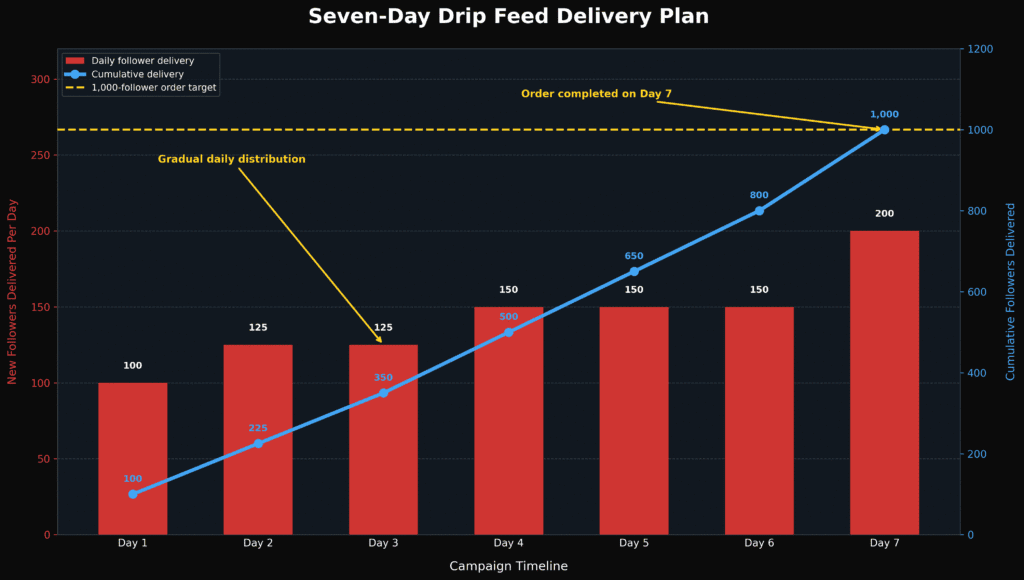
Building a seven day growth schedule requires structuring intervals to align with target audience active hours:
- Hourly Batches over 12 Hours: Set interval to 60, set runs to 12. Ideal for fast video distribution.
- Twice-Daily Batches (Every 12 Hours): Set interval to 720, set runs to 14 for a full week campaign.
- Daily Batches (Every 24 Hours): Set interval to 1440, set runs to 7 for steady weekly growth.
- Custom Interval Pacing: Set interval to 480 (8 hours), set runs to 21 for three daily updates across seven days.
- Weekend Surge Schedule: Set interval to 360 (6 hours) during peak Friday to Sunday traffic windows.
Pacing your growth schedule prevents sudden activity spikes that draw scrutiny from network security systems. Setting daily batches creates continuous engagement signals, encouraging algorithms to distribute content to organic feeds.
Structuring schedule frameworks around published content releases yields superior performance results. When uploading a new video post, scheduling a drip feed run to execute 30 minutes post-publish creates early engagement signals that trigger recommendation engines.
Adjusting run intervals to match audience peak activity hours prevents unnatural off-peak metric spikes. Executing runs during local daytime hours maintains contextual credibility across account analytics.
Why Is Your Drip Feed Order Stuck Between Batches?
An order status showing “In Progress” or “Processing” between cycles indicates standard system behavior. When execution stalls beyond your specified interval window, check these common technical triggers:
- Sequential Timer Delays: System interval timers begin after a batch finishes processing. High network load extending batch completion times delays subsequent run start times.
- Target Link Changes: Modifying profile handles, setting accounts to private, or altering target post links breaks system routing.
- Server Execution Queues: High platform order volume creates temporary delays across scheduled background tasks.
- Service Maximum Caps: Reaching maximum capacity limits for a selected service pauses remaining runs automatically.
- Wallet Balance Limits: Insufficient funds for pending runs force automated system pauses.
Order processing algorithms handle millions of data transfers daily. Temporary queue backups occur during high-traffic updates across major social networks. Automated engines resume scheduled runs once server load clears.
Modifying URL structures mid-campaign invalidates API targets. Keeping accounts public and links unchanged ensures uninterrupted batch delivery.
How Can You Avoid Ordering More Than You Intended?
Prevent wallet depletion errors by using a pre-checkout verification routine:
- Multiply your entered run quantity by total runs to confirm final unit output.
- Verify interval inputs in minutes; 24 hours equals 1440 minutes, while 12 hours equals 720 minutes.
- Ensure target URLs remain public and active throughout the entire campaign schedule.
- Review final wallet deduction totals before confirming the order submission.
- Run a small single-batch test order to verify URL formatting before scheduling multi-run campaigns.
Double-checking math before submitting orders prevents accidental wallet deductions. Careful setup ensures campaign execution aligns with strategic goals.
Developing systematic verification habits prevents simple setup mistakes. Reviewing order parameters carefully ensures marketing spend remains controlled across long-term growth campaigns.
Comparing system setup mechanics highlights the operational trade-offs between rapid delivery and staggered campaigns.
Compare Instant & Gradual Delivery Risks And Costs

Choosing a delivery style requires balancing account safety, campaign deadlines, and budget efficiency. Evaluating instant delivery risks for new accounts helps users avoid permanent reach suppression. When you purchase metrics through growth panels, understanding how speed affects your wallet and your profile security makes all the difference.
Instant delivery pushes every single follower or like to your profile within minutes of placing the order. While this rapid influx creates immediate social proof, it introduces significant financial and algorithmic hazards. Platforms monitor sudden surges closely, often flagging accounts that experience unnatural traffic spikes.
If a platform detects abnormal activity, your content distribution can drop instantly, neutralizing any marketing momentum you just paid for. Furthermore, instant batches suffer from higher drop rates because automated security filters regularly purge low-quality profiles. Replacing those lost metrics requires additional purchases, which increases your total long-term costs.
Gradual delivery takes the opposite approach by spreading your order out over hours or days. This controlled pacing mimics authentic viral growth curves, keeping your account safe from algorithmic penalties. Because the incoming traffic looks natural, retention rates remain much higher, saving you money on replacement fees.
However, gradual delivery requires patience, which can conflict with tight promotional windows or urgent marketing schedules.
Weighing these financial trade-offs and safety factors ensures your growth strategy remains sustainable. Careful planning protects both your budget and your long-term online reputation.
Can Sudden Follower Spikes Affect New Social Media Accounts?
Unusual activity spikes present risks for brand new or long-dormant profiles. Platform moderation networks evaluate account activity against historical baselines. Searchers often wonder why an overnight follower spike looks suspicious to platform security networks.
According to the DataReportal Global Digital Overview, over 5 billion people actively use social media networks worldwide, prompting platforms to implement strict automated moderation to manage artificial traffic. When a new page gains thousands of followers overnight, anomaly filters trigger reviews. Asking can a sudden jump get my account flagged is valid; security systems flag rapid influxes on unverified pages.
Common outcomes of unmanaged spikes include:
- Reach Suppression: Organic content distribution drops as systems restrict unverified growth surges.
- Account Identity Checks: Platforms request immediate identity, phone, or email verification to restore access.
- Engagement Dilution: Gaining thousands of followers without matching likes or comments drops profile engagement rates below active performance benchmarks.
- Shadowbanning: Post visibility on hashtag hubs and search discovery grids drops significantly.
- Temporary Feature Locks: Liking, commenting, or direct messaging capabilities get restricted for up to 14 days.
Understanding safe order size for a small page helps prevent account suspensions. Asking how fast is too fast for a new Instagram account leads creators toward gradual pacing models. Overcoming bulk delivery and reach suppression requires aligning orders with content publishing schedules.
Profile managers scaling new accounts can reference insights on how Nigerian brands use social media boosters to grow faster to align order speed with baseline account activity.
Automated security networks analyze behavioral patterns, comparing traffic sources, IP geographical locations, and metric arrival timing. High metric surges arriving from concentrated server blocks alert anomaly filters instantly.
Pacing metric volume simulates realistic human discovery behaviors, allowing account expansion to blend into standard platform traffic patterns without triggering account flags.
Does Drip Feed Reduce The Risk Of Follower Drops?

Paced delivery lowers visible drop spikes by staggering metric additions over time. Many buyers ask if drip feed versus instant for a brand new account offers better protection against algorithm sweeps.
Security sweeps clear inactive or automated accounts periodically. Receiving thousands of followers in a single drop means security filters clear them in one noticeable decline, leaving a sharp dip on public analytics graphs.
Staggered arrivals ensure drops occur in small, isolated waves. This prevents sudden metric drops on public charts while allowing automatic refill features to maintain target metrics smoothly.
Automated refill systems process balance corrections far more efficiently during staggered campaigns. When minor drops occur across early batches, ongoing runs replace lost units before total metric counts drop publicly.
Staggered delivery provides an operational buffer, protecting public social proof indicators from displaying sudden count reductions.
Why Does Gradual Delivery Not Fix Poor Service Quality?
A low-tier metric order remains unreliable regardless of distribution speed. When profiles lack proper setup or originate from low-grade networks, stretching the delivery timeline out over several days fails to correct those fundamental flaws.
Understanding why pacing cannot mask poor underlying metrics helps you prioritize quality right from the start. Spreading inferior profiles across a two-week window still results in heavy metric drops once platform security sweeps occur.
Consider these key reasons why gradual delivery cannot compensate for low service quality:
- Inadequate Node Integrity: Low-grade profiles often lack authentic activity, clear profile photos, or complete bios, making them easy targets for automated platform purges regardless of how slowly they arrive.
- Unchanged Account Details: Pacing your order does nothing to fix poor profile imagery, empty timelines, or missing user data that signal fake accounts to modern algorithms.
- Inevitable Security Sweeps: Standard platform cleanups target dormant connections consistently, meaning slow delivery only delays the moment those inactive profiles disappear.
- False Security Sense: Spreading out weak metrics can trick creators into thinking an order is safe simply because numbers rise slowly, masking underlying retention risks.
- Wasted Campaign Budgets: Investing in slow delivery for low-tier sources simply drags out the disappointment of losing followers the moment a routine algorithm update hits.
Focusing on service quality, high retention rates, and reliable guarantees matters far more than speed alone. High-tier infrastructure provides stable profiles that hold genuine value over time.
Prioritizing robust foundational standards ensures your growth efforts produce lasting results instead of temporary numbers that vanish under scrutiny.
Is Drip Feed More Expensive Than Instant Delivery?

Evaluating drip feed cost versus instant pricing reveals key budget insights. Paced delivery costs the exact same rate per unit as instant delivery on transparent platforms. Buyers questioning is drip feed more expensive than instant often confuse software settings with service pricing. Platforms rarely charge extra for scheduled delivery, making the price difference between paced and bulk orders non-existent when calculated accurately.
Higher drip feed costs result entirely from entering total target quantities into single-run fields. Entering 1,000 units across 5 runs submits an order for 5,000 total units, multiplying checkout costs by five. Understanding the naira cost of splitting an order into runs prevents checkout errors, while recognizing the value of drip feed for large budgets allows brand managers to stretch marketing spend across entire campaign cycles.
The table below demonstrates budget allocations across delivery modes, confirming that unit rates remain identical when entry parameters are calculated correctly:
| Target Goal | Selected Mode | Entry Setup (Qty x Runs) | Total Units | Rate per 1,000 | Total Naira Cost | Cost Premium |
| 2,000 Followers | Instant | 2,000 x 1 Run | 2,000 | ₦2,500 | ₦5,000 | ₦0 (Base) |
| 2,000 Followers | Drip Feed | 500 x 4 Runs | 2,000 | ₦2,500 | ₦5,000 | ₦0 (Identical) |
| 5,000 Views | Instant | 5,000 x 1 Run | 5,000 | ₦800 | ₦4,000 | ₦0 (Base) |
| 5,000 Views | Drip Feed | 1,000 x 5 Runs | 5,000 | ₦800 | ₦4,000 | ₦0 (Identical) |
| 10,000 Likes | Drip Feed Error | 10,000 x 5 Runs | 50,000 | ₦1,200 | ₦60,000 | ₦48,000 (User Error) |
How to Choose A Safe And Practical Social Media Growth Pace

Selecting between delivery modes requires matching campaign pace to baseline account activity. Safe pacing requires consistent timing. Understanding how to execute matching delivery mode to service type protects account safety while building sustainable momentum. When you start scaling your profiles, rushing the process often invites algorithmic flags that can stall your reach.
To establish a sustainable cadence, follow this practical process:
- Calculate Baseline: Review interactive analytics to determine average daily follower, like, and view counts. Knowing your organic numbers helps you select delivery speeds that mirror real human interest rather than raising red flags.
- Evaluate Campaign Goals: Determine whether you need immediate social proof for a product launch or steady, long-term audience building over several weeks.
- Match Service Types: Assign instant delivery exclusively to time-sensitive promotional views, while reserving drip-fed pacing for follower counts and profile subscriptions.
- Monitor Platform Response: Watch your engagement rates closely during the first twenty-four hours after an order begins to ensure platform algorithms accept the traffic smoothly.
- Adjust Pacing: Tweak your interval settings immediately if you notice sudden drops or restricted content distribution, slowing down future batches to protect your account standing.
Taking a methodical approach prevents sudden visibility drops and protects your budget from wasted investments. Matching your growth speed to your actual content output ensures your community expands organically and securely over the long run.
How Can You Match Delivery To Your Recent Growth Rate?
The safest delivery speed scales directly from past account performance. Experienced media strategists rely on the 1x to 3x Baseline Rule. Deciding on drip feed for followers or views depends on current content velocity.
While instant delivery for launch window views works well for viral campaigns, determining when likes need same day delivery ensures engagement spikes look contextually appropriate. Knowing which services should never be drip fed prevents campaign delays.
- Calculate Baseline: Review internal page analytics to determine average daily follower, view, or like gains over the last 30 days.
- Apply Multipliers: Set daily drip feed targets at two to three times your baseline average.
- Scale Gradually: As organic performance expands, increase daily run quantities for subsequent orders.
- Align Content Strategy: Increase posting frequency to match incoming metric volume.
- Monitor Analytics: Pause or adjust drip feed settings if organic reach metrics begin to stall.
Creators looking to register an account and configure custom growth schedules can visit Sizzle Social Sign Up to access automated growth dashboards.
Applying the multiplier rule keeps profile growth aligned with platform safety guidelines. When an account averaging ten followers daily suddenly scales to thirty daily followers via drip feed, security filters recognize standard performance expansion.
Scaling metric requests alongside publishing schedules validates audience increases, encouraging algorithms to distribute posts to broader target feeds.
Why Should You Avoid Sudden Changes In Daily Activity?

Algorithms distribute content based on historical activity trends. Sudden metric changes prompt system security audits. Establishing proper growth pacing for Nigerian brands and launches prevents artificial flag triggers.
When a vendor profile averaging fifty likes per post suddenly receives ten thousand likes within three minutes, automated checks register an operational mismatch. Pacing follower counts is critical when pacing follower growth during a product launch or executing gradual growth for vendors building trust across local e-commerce networks.
Maintain balanced engagement ratios across active content:
- Likes to Views: Aim for a 3% to 10% like-to-view ratio on video uploads.
- Comments to Likes: Maintain roughly 1 comment per 20 to 50 post likes.
- Followers to Interactions: Ensure post interactions increase alongside total profile follower count.
- Shares to Views: Maintain 1 share per 50 to 100 video views to signal strong viral appeal.
- Profile Visits to Followers: Ensure profile visits scale in proportion to new follower additions.
Disproportional post metrics harm algorithmic distribution. A post displaying ten thousand likes alongside zero comments alerts evaluation software to automated traffic manipulation.
Distributing metric requests across likes, views, and comments maintains realistic engagement profiles, protecting account authority across platform feeds.
How Can You Monitor Runs And Completed Delivery Batches?

Managing multi-stage campaigns requires tracking your control dashboard between scheduled runs. Setting up a drip feed for monthly retainers or arranging an instant boost for a trending post requires continuous oversight.
Monitor key dashboard fields for smooth campaign execution:
- Remains Field: Displays remaining unit totals across pending runs.
- Runs Completed: Shows current completed batches against total requested runs (e.g., 3/10).
- Logs & Order Status: Confirms whether previous batches completed successfully or encountered processing delays.
- Interval Countdown: Indicates exact minutes remaining before the next scheduled run triggers.
- Deducted Balance: Displays total funds deducted for completed run cycles.
System log monitoring helps identify delivery bottlenecks before campaign schedules stall. When dashboard logs indicate a batch delay, checking link accessibility or service capacity status helps resolve processing issues quickly.
Tracking batch arrivals alongside publishing calendars helps maintain steady profile growth throughout multi-week promotional campaigns.
What Should You Do When Delivery Ignores Your Selected Mode?
If an order processes instantly despite enabling drip feed options, or if batch delivery stalls:
- Verify Order History: Confirm the drip feed selection was saved prior to order confirmation.
- Check Entry Parameters: Ensure input fields contained no extra characters or formatting errors during checkout.
- Pause Overlapping Requests: Avoid placing duplicate requests on the same URL while a campaign runs. Simultaneous processing creates server queue conflicts.
- Contact Support with Details: Open a ticket containing your Order ID, target URL, and dashboard batch screenshots.
Technical glitches occur rarely when server updates coincide with order submissions. If a scheduler option fails to save, API endpoints execute requests via standard instant queues.
Submitting exact dashboard order parameters to support staff speeds up manual queue adjustments, preserving campaign timelines.
Evaluating system performance leads to determining the right delivery approach for your target metrics.
Instant Or Gradual Social Media Growth: Which Is Better?
Neither delivery style is universally superior; operational value depends on campaign goals, account history, and project deadlines. When evaluating instant vs gradual social media growth, profile managers must weigh immediate visibility needs against long-term account authority.
Asking fast growth or gradual growth which is safer leads back to account context. Instant delivery provides value during short-term promotion windows, live broadcasts, and launch events requiring immediate social proof. Drip feed delivery provides the stability needed for long-term account development, brand launches, and ongoing client retainers, blending metrics into account activity curves smoothly. Deciding should I choose drip feed or instant followers comes down to balancing campaign speed against profile safety.
FrequentlyAsked Questions
Instant delivery dispatches the entire ordered metric volume to a target link as fast as platform routing servers process incoming network requests. Once a checkout transaction completes, automated networks handle the instruction, fulfilling thousands of interactions within minutes or hours depending on platform server load. Fast processing suits specific emergency marketing goals, such as pushing a sudden viral trend or meeting tight public media deadlines. However, sending high metric volumes instantly to fresh profiles creates technical footprints that moderation software tracks easily. High velocity metric acquisition produces immediate visual transformation across account frontends. Placing an instant order sends signal bursts to platform routing nodes, resulting in rapid metric additions. This approach serves campaign scenarios requiring immediate social proof to influence human profile visitors during tight operational windows. Specific short term marketing scenarios benefit from rapid delivery, including elevating a live broadcast stream, driving direct traffic to a time sensitive announcement, pushing a video post during its initial evaluation window, countering rapid metric drops during a competitive launch event, fulfilling tight agency deadlines, creating immediate visual density on brand launching pages, and supporting time limited flash sales.
Gradual or drip feed delivery divides a bulk request into smaller controlled batches sent over scheduled time windows. Rather than receiving 5,000 interactions in one drop, the platform splits order volume into manageable runs across several days. Paced distribution relies on automated queue systems that release defined metric allocations at pre set time intervals. Setting an order for 2,000 followers over four days releases 500 followers every 24 hours, and this controlled sequence simulates organic discovery patterns, helping overall account activity align with algorithmic safety thresholds. Campaign parameters require five specific inputs: quantity per run, which is the exact number of units sent per batch execution, runs, which is the total number of batches to execute across the schedule, interval, which is the delay time in minutes between consecutive batches, start delay, which is optional initial buffer time before the first run triggers, and target link, which is the active profile or content URL receiving the metrics. Paced distribution mimics natural audience expansion, since recommendation engines register ongoing profile interest instead of isolated metric spikes, keeping account trust metrics intact while building sustained platform authority.
Evaluating delivery speeds requires matching platform mechanics to your marketing objectives. Rapid delivery suits short term campaigns where immediate metric displays take priority over platform safety filters. Paced delivery fits long term profile optimization, offering safe integration with existing organic reach curves. The operational differences dictate how platform algorithms index incoming engagement. Instant delivery executes in minutes to hours and creates a concentrated metric surge, making it best for live streams, urgent trends, and time sensitive posts. Gradual delivery executes over days to weeks and creates a smooth natural curve, making it best for profile building, brand launches, and ongoing retainers. Instant delivery carries higher audit risk on new or inactive accounts, while gradual delivery carries minimal risk when matched to account baseline. Setup complexity differs too: instant delivery requires a single entry where you select quantity and submit, while gradual delivery requires basic math involving quantity times runs times interval. Order control also differs, since instant delivery arrives in a single wave while gradual delivery is monitored batch by batch. Choosing between execution modes depends heavily on post context and campaign requirements.
Slower delivery speed does not guarantee higher follower retention on its own. Drip feed functions purely as an execution scheduler, managing delivery timing rather than profile quality. Spreading lower tier network accounts over seven days merely delays audience drop off, since profile purges still clear non engaging accounts once platform security audits run. Long term retention relies on profile authenticity, account stability, and platform refill guarantees. Controlled pacing prevents rapid security flags, but holding metric gains requires choosing high grade services backed by solid quality guarantees. Spreading metric distribution over extended timeframes protects account status, but baseline profile quality determines long term follower counts. The retention evaluation matrix is clear: high quality profiles plus paced delivery equals optimal retention and maximum safety, while low quality profiles plus paced delivery equals delayed drops and temporary metric gains. Audience purges occur when network security software scans database records for inactive profile flags. Accounts lacking profile photos, custom biographic data, or activity logs get identified during automated system sweeps regardless of initial arrival speed, so profile quality remains the deciding factor.
Setting up a multi stage campaign without technical errors requires understanding five basic parameters. Quantity per run is the precise unit amount sent in one batch execution. Runs is the total number of iterations the system performs over time. Interval is the rest period in minutes between the completion of one batch and the start of the next. Total order volume is the combined total of units delivered when all runs conclude, and batch status is the real time processing state of an active run cycle. As an example, 200 units per run multiplied by 5 runs equals 1,000 total units delivered, and an interval of 1,440 minutes, which equals 24 hours, creates a total time of 5 days. Understanding these terms prevents common campaign management errors. Setting quantity to the overall campaign target rather than the single run amount leads to budget overruns and excess unit delivery. Automated order portals calculate total charges by processing entered parameters before execution, so entering values accurately ensures campaign delivery schedules align with allocated marketing funds.
Enter accurate values into order forms to avoid unexpected overcharges. Enter the single batch target into the quantity field, not your total campaign goal. To calculate total volume delivered, multiply quantity per run by total runs. To calculate total order cost, divide total volume delivered by 1,000 and multiply by the rate per 1,000. Consider a setup example with a target of 2,000 followers over 4 days. If you want 4 runs executed once every 24 hours, divide 2,000 by 4 to get 500. Your form entries should be quantity of 500, runs of 4, and interval of 1,440, which represents 60 minutes times 24 hours. Entering 2,000 into the quantity input with 4 runs places an order for 8,000 followers, deducting four times your intended budget from your wallet balance. A common math error looks like entering 1,000 quantity with 10 runs, which delivers 10,000 units and creates an unexpected 10 times cost. The correct setup would be 100 quantity with 10 runs to deliver 1,000 units at your intended budget spend.
Building a seven day growth schedule requires structuring intervals to align with target audience active hours. Hourly batches over 12 hours work by setting the interval to 60 and runs to 12, which is ideal for fast video distribution. Twice daily batches every 12 hours work by setting the interval to 720 and runs to 14 for a full week campaign. Daily batches every 24 hours work by setting the interval to 1,440 and runs to 7 for steady weekly growth. Custom interval pacing works by setting the interval to 480, which equals 8 hours, and runs to 21 for three daily updates across seven days. A weekend surge schedule works by setting the interval to 360, which equals 6 hours, during peak Friday to Sunday traffic windows. Pacing your growth schedule prevents sudden activity spikes that draw scrutiny from network security systems. Setting daily batches creates continuous engagement signals, encouraging algorithms to distribute content to organic feeds. Structuring schedule frameworks around published content releases yields superior performance results, since scheduling a drip feed run to execute 30 minutes post publish creates early engagement signals that trigger recommendation engines.
An order status showing in progress or processing between cycles indicates standard system behavior. When execution stalls beyond your specified interval window, check these common technical triggers. Sequential timer delays occur because system interval timers begin after a batch finishes processing, so high network load extending batch completion times delays subsequent run start times. Target link changes break system routing, including modifying profile handles, setting accounts to private, or altering target post links. Server execution queues create temporary delays across scheduled background tasks during high platform order volume. Service maximum caps pause remaining runs automatically when reaching maximum capacity limits for a selected service. Wallet balance limits force automated system pauses when funds are insufficient for pending runs. Order processing algorithms handle millions of data transfers daily, and temporary queue backups occur during high traffic updates across major social networks. Automated engines resume scheduled runs once server load clears. Modifying URL structures mid campaign invalidates API targets, so keeping accounts public and links unchanged ensures uninterrupted batch delivery.
Prevent wallet depletion errors by using a pre checkout verification routine. Multiply your entered run quantity by total runs to confirm final unit output. Verify interval inputs in minutes, remembering that 24 hours equals 1,440 minutes while 12 hours equals 720 minutes. Ensure target URLs remain public and active throughout the entire campaign schedule. Review final wallet deduction totals before confirming the order submission. Run a small single batch test order to verify URL formatting before scheduling multi run campaigns. Double checking math before submitting orders prevents accidental wallet deductions, and careful setup ensures campaign execution aligns with strategic goals. A useful pre flight checkout checklist includes confirming that the quantity entered represents one single run rather than the total goal, the total runs count matches the target campaign duration, the interval value is converted correctly into minutes, the target profile is set to public visibility, and the available wallet balance covers the total calculated cost. Developing systematic verification habits prevents simple setup mistakes, and reviewing order parameters carefully ensures marketing spend remains controlled across long term growth campaigns.
Unusual activity spikes present risks for brand new or long dormant profiles, since platform moderation networks evaluate account activity against historical baselines. A normal account pattern might show plus 2 followers on day one, plus 5 on day two, and plus 3 on day three, which registers as natural status. An unnatural spike pattern shows plus 2 followers on day one and plus 10,000 followers overnight, which triggers a security review flag. According to the DataReportal Global Digital Overview, over 5 billion people actively use social media networks worldwide, prompting platforms to implement strict automated moderation to manage artificial traffic. When a new page gains thousands of followers overnight, anomaly filters trigger reviews. Common outcomes of unmanaged spikes include reach suppression, where organic content distribution drops as systems restrict unverified growth surges, account identity checks requesting immediate verification, engagement dilution where profile engagement rates drop below active benchmarks, shadowbanning where post visibility on hashtag hubs drops significantly, and temporary feature locks restricting liking or commenting for up to 14 days.
Paced delivery lowers visible drop spikes by staggering metric additions over time. Security sweeps clear inactive or automated accounts periodically. Receiving thousands of followers in a single drop means security filters clear them in one noticeable decline, leaving a sharp dip on public analytics graphs. A bulk drop pattern shows 5,000 followers coming in, followed by an instant audit and a 4,000 drop overnight. A staggered pattern shows 1,000 followers on day one, 1,000 on day two, and a gradual adjustment afterward. Staggered arrivals ensure drops occur in small isolated waves, which prevents sudden metric drops on public charts while allowing automatic refill features to maintain target metrics smoothly. Automated refill systems process balance corrections far more efficiently during staggered campaigns. When minor drops occur across early batches, ongoing runs replace lost units before total metric counts drop publicly. Staggered delivery provides an operational buffer, protecting public social proof indicators from displaying sudden count reductions. However, pacing low quality metrics only produces a staggered purge with an eventual drop, while pacing high quality metrics produces sustainable growth.
Paced delivery costs the exact same rate per unit as instant delivery on transparent platforms. Platforms rarely charge extra for scheduled delivery, making the price difference between paced and bulk orders non existent when calculated accurately. A standard order of 1,000 followers at ₦2,000 per thousand costs ₦2,000, and a drip feed order of 250 followers across 4 runs at ₦2,000 per thousand also costs ₦2,000. Higher drip feed costs result entirely from entering total target quantities into single run fields. Entering 1,000 units across 5 runs submits an order for 5,000 total units, multiplying checkout costs by five. Understanding the Naira cost of splitting an order into runs prevents checkout errors, while recognizing the value of drip feed for large budgets allows brand managers to stretch marketing spend across entire campaign cycles. The cost structure analysis confirms that instant execution uses total units divided by 1,000 multiplied by base rate, while paced execution uses quantity per run times total runs, divided by 1,000, multiplied by base rate, producing standardized unit pricing across both modes.
The safest delivery speed scales directly from past account performance. Experienced media strategists rely on the 1x to 3x baseline rule. First, calculate your baseline by reviewing internal page analytics to determine average daily follower, view, or like gains over the last 30 days. Next, apply multipliers by setting daily drip feed targets at two to three times your baseline average. Then scale gradually, increasing daily run quantities for subsequent orders as organic performance expands. Align your content strategy by increasing posting frequency to match incoming metric volume, and monitor analytics by pausing or adjusting drip feed settings if organic reach metrics begin to stall. The pacing rules framework shows that a baseline under 10 daily units allows a maximum paced addition of 20 to 30 units daily, a baseline of 100 daily units allows 200 to 300 units daily, and a baseline over 1,000 daily units allows 2,000 to 3,000 units daily, all using a 3x scale factor. Applying the multiplier rule keeps profile growth aligned with platform safety guidelines.
Algorithms distribute content based on historical activity trends, and sudden metric changes prompt system security audits. When a vendor profile averaging fifty likes per post suddenly receives ten thousand likes within three minutes, automated checks register an operational mismatch. A mismatched post might show 10,000 likes alongside 2 retweets, 0 comments, and 15 profile visits, and the result is that the algorithm identifies non organic patterns and limits reach. To maintain balanced engagement ratios across active content, aim for a 3% to 10% like to view ratio on video uploads, maintain roughly 1 comment per 20 to 50 post likes, ensure post interactions increase alongside total profile follower count, maintain 1 share per 50 to 100 video views to signal strong viral appeal, and ensure profile visits scale in proportion to new follower additions. A cohesive engagement signal might show a video upload reaching 1,000 views, 50 to 100 likes, 5 to 10 comments, and 2 to 5 shares, which represents maximum reach potential. Disproportional post metrics harm algorithmic distribution.
If an order processes instantly despite enabling drip feed options, or if batch delivery stalls, follow several diagnostic steps. Verify order history by confirming the drip feed selection was saved prior to order confirmation. Check entry parameters to ensure input fields contained no extra characters or formatting errors during checkout. Pause overlapping requests by avoiding duplicate requests on the same URL while a campaign runs, since simultaneous processing creates server queue conflicts. Contact support with details by opening a ticket containing your Order ID, target URL, and dashboard batch screenshots. The system exception resolution steps are to check the order receipt, confirm the drip flag is active, capture a system screenshot, and submit a support ticket. Technical glitches occur rarely when server updates coincide with order submissions. If a scheduler option fails to save, API endpoints execute requests via standard instant queues. Submitting exact dashboard order parameters to support staff speeds up manual queue adjustments, preserving campaign timelines. Neither delivery style is universally superior, since operational value depends on campaign goals, account history, and project deadlines.